Backflow Prevention
A list of persons certified under the Georgia Statewide Backflow Prevention Assembly Certification Program (GBPAT) is maintained by the Georgia Association of Water Professionals (GAWP), the State’s authorized testing party, at http://www.gawp.org/page/Backflow. The page allows you to “Search Testers”. If you do a general search, it will provide a listing of the current testers. Note that not every tester certified offers the service commercially.
You may also email the application to tloera@dallas-ga.gov.
All testing and applications must be submitted by April 1st.
Questions? Please contact Bubba Cobb at 770-443-8110 ext. 1503.
Why does the City of Dallas have this program?
The Georgia Environmental Protection Division (EPD) requires the City of Dallas to have a backflow program. This program is designed to protect the public water supply from pollutants and contaminants that could, under certain circumstances, be drawn into the city water system from private properties.
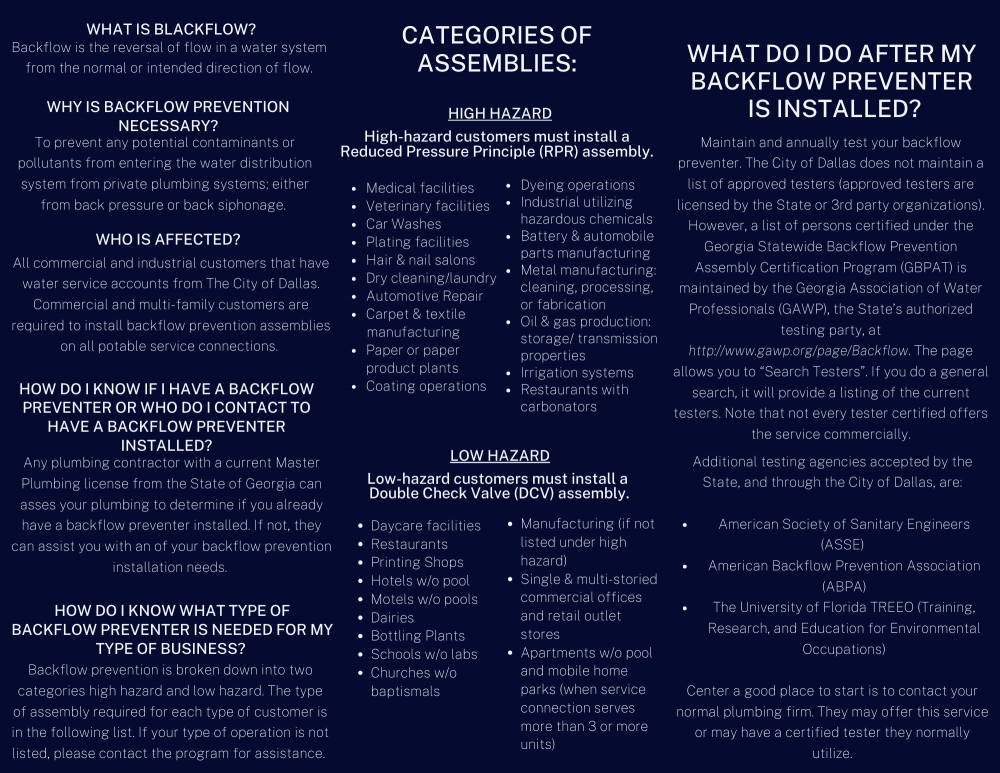
WHAT IS BLACKFLOW?
Backflow is the reversal of flow in a water system from the normal or intended direction of flow.
WHY IS BACKFLOW PREVENTION
NECESSARY?
To prevent any potential contaminants or pollutants from entering the water distribution system from private plumbing systems; either from back pressure or back siphonage.
WHO IS AFFECTED?
All commercial and industrial customers that have water service accounts from The City of Dallas. Commercial and multi-family customers are required to install backflow prevention assemblies on all potable service connections.
HOW DO I KNOW IF I HAVE A BACKFLOW
PREVENTER OR WHO DO I CONTACT TO
HAVE A BACKFLOW PREVENTER
INSTALLED?
Any plumbing contractor with a current Master Plumbing license from the State of Georgia can assess your plumbing to determine if you already have a backflow preventer installed. If not, they can assist you with an of your backflow prevention installation needs.
HOW DO I KNOW WHAT TYPE OF
BACKFLOW PREVENTER IS NEEDED FOR MY
TYPE OF BUSINESS?
Backflow prevention is broken down into two categories: high hazard and low hazard. The type of assembly required for each type of customer is in the following list. If your type of operation is not listed, please contact the program for assistance.
CATEGORIES OF ASSEMBLIES: HIGH HAZARD
High-hazard customers must install a Reduced Pressure Principle (RPR) assembly.
- Medical facilities
- Veterinary facilities
- Car Washes
- Plating facilities
- Hair & nail salons
- Dry cleaning/laundry
- Automotive Repair
- Carpet & textile manufacturing
- Paper or paper product plants
- Coating operations
- Dyeing operations
- Industrial utilizing hazardous chemicals
- Battery & automobile parts manufacturing
- Metal manufacturing: cleaning, processing, or fabrication
- Oil & gas production: storage/ transmission properties
- Irrigation systems
- Restaurants with carbonators
LOW HAZARD
Low-hazard customers must install a Double Check Valve (DCV) assembly.
- Daycare facilities
- Restaurants
- Printing Shops
- Hotels w/o pool
- Motels w/o pools
- Dairies
- Bottling Plants
- Schools w/o labs
- Churches w/o baptismals
- Manufacturing (if not listed under highhazard)
- Single & multi-storied commercial offices and retail outlet stores
- Apartments w/o pool and mobile home parks (when service connection serves more than 3 or more units)